


| archives • main |
| archives • main |
|
VOYEURISM When David stopped waking up every 35 minutes, we made a pact never to go into his room in the middle of the night and with few exceptions we've stuck to the rule. Lately, our little boy picked up two interesting habits that make us wander what he does behind closed doors. First of all, he randomly wakes up at all hours and shrieks like his eyeballs are being plucked right out. The sounds are so scary that you're convinced he must be bleeding. However, two seconds after I walk in, he's in great humors and pointing to the door and making the enthusiastic sounds of "please let me out so I can play." Secondly, he has managed to master zippers, pants, diapers and any other forms of clothing such that he can go from fully dressed to stark naked within seconds. He loves doing this during naps and in the morning before we even know he's awake. For all we know, he does it in the middle of the night. What we do know is that we come in and he's naked. The bed holds what would usually be so well covered by the diaper. Add to that, the fact that David loves pooping first thing in the morning and you should have a good visual of our morning surprises. To get a better sense of exactly what's going on behind the dark, closed doors, we just bought a baby video monitor. This lets me watch David all night long and it has quickly become my favorite channel.  TRANQUILITY  BUTTERFLIES AROUND PISMO BEACH  AVILA BEACH 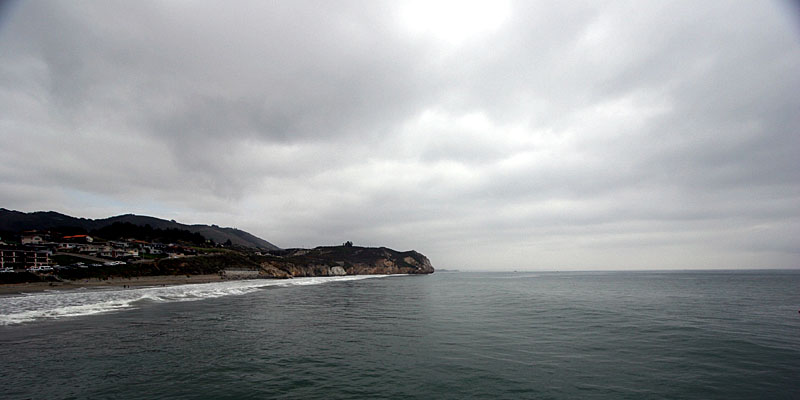 TURNING TWO AND BLISS 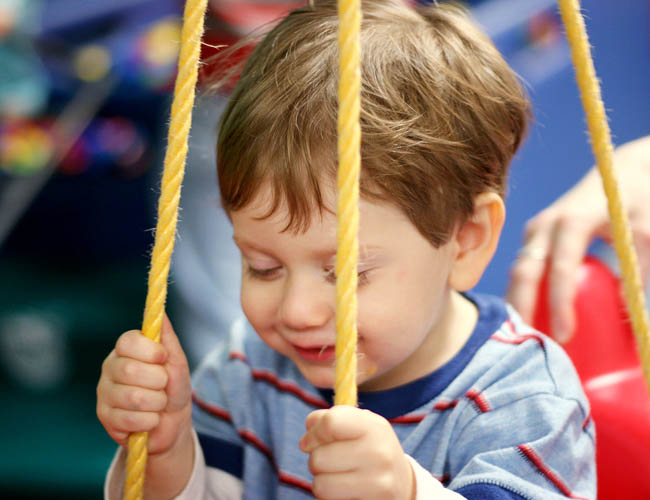 SKYLINE PART II  SKYLINE PART I  FIVE BOOKS: BERG AND QUINDLEN  We
Are All Welcome Here is Elizabeth Berg's newest novel. (There's a
newer one coming out in May.) I am a huge fan of hers and was thrilled
to find this book at the library. To be honest, it wasn't a favorite of
mine. While I thought the story was beautiful and touching, it wasn't as
strong as many of her others. Berg has a distinct skill of writing about
women and not making it cheesy or fluffy.
We
Are All Welcome Here is Elizabeth Berg's newest novel. (There's a
newer one coming out in May.) I am a huge fan of hers and was thrilled
to find this book at the library. To be honest, it wasn't a favorite of
mine. While I thought the story was beautiful and touching, it wasn't as
strong as many of her others. Berg has a distinct skill of writing about
women and not making it cheesy or fluffy.
 Three little books from Anna Quindlen, another powerful and strong female author: Peing Perfect, How Reading Changed My Life and A short Guide to a Happy Life. I was interested in all of these books but didn't want to pay the list price for such a small book that I knew would be an hour read.  Thanks to the Palo Alto Library, I finally got my hands on them and was able to read the lovely little stories which really should have been essays and not books of their own. To be fair, the reading book did recommend many awesome books to me that I love. 
And finally I just finished Anna Quindlen's latest book, Rise and Shine. Since the story was about two sisters and took place in New York, I really looked forward to reading it. Quindlen is a fantastic author so, of course, the book wasn't bad. However, it wasn't great either. I felt that she has done and could have done a lot better. The characters were just not three-dimensional enough.  I didn't feel
sympathetic towards either of the sisters and felt like some of the
major plot points were either implausible or unnecessarily dramatic. I had a pretty hard time getting into the story and I kept waiting for it to get more interesting and for something to happen. And when it finally did, I compeltely didn't believe it. It felt like a cop-out. However, when I got to the end of the book, the last two lines spoke to the core of the story and made me remember why I love her so much.
I didn't feel
sympathetic towards either of the sisters and felt like some of the
major plot points were either implausible or unnecessarily dramatic. I had a pretty hard time getting into the story and I kept waiting for it to get more interesting and for something to happen. And when it finally did, I compeltely didn't believe it. It felt like a cop-out. However, when I got to the end of the book, the last two lines spoke to the core of the story and made me remember why I love her so much.
Another fantastic female author and one of my very favorites is Jane Smiley. And I am delighted that I'll be getting to hear her talk this week (cross fingers). Now I need a new book by Anne Tyler and I will be all set. THE DEVIL AND MISS PRYM  I am a huge fan of Paulo Coelho. I have read most of his novels and
found every one of them to be thought provoking and un-putdownable. And
The
Devil and Miss Prym was no exception. I read the entire novel in a
day and loved every moment of it. This one is an interesting study of
human morality. Or lack thereof. Books with this topic always make me
think of Lord of the Flies which I think is the ultimate story of human
nature.
I am a huge fan of Paulo Coelho. I have read most of his novels and
found every one of them to be thought provoking and un-putdownable. And
The
Devil and Miss Prym was no exception. I read the entire novel in a
day and loved every moment of it. This one is an interesting study of
human morality. Or lack thereof. Books with this topic always make me
think of Lord of the Flies which I think is the ultimate story of human
nature.
Playing the part of a charitable soul was only for those who were afraid of taking a stand in life. It is always far easier to have faith in your own goodness than to confront others and fight for your rights. It is always easier to hear an insult and not retaliate than have the courage to fight back against someone stronger than yourself; we can always say we're not hurt by the stones others throw at us, and it's only at night - when we're alone and our wife our husband or our school friend is asleep - that we can silently grieve over our own cowardice. ... Not a single voice in the crowd was raised against the choice. The mayor was glad because they had accepted his authority; but the priest knew that this could be a good or a bad sign, because silence does not always mean consent - usually all it meant was that people were incapable of coming up with an immediate response. If someone did not agree, they would later torture themselves with the idea that they had accepted without really wanting to, and the consequences of that would be grave. There's something about Paulo Coelho that I completely connect with and I cannot describe in words. The Paradox of Choice  I can't even remember where I read about Paradox of Choice. All in all, it wasn't the most interesting book I read. I
flipped through a lot of the pages but did read many passages with a
lot of interesting thoughts. There are a lot of passages from this one
and honestly each deserve their own posts, but I figure let's document
this first, I can always come back to them.
I can't even remember where I read about Paradox of Choice. All in all, it wasn't the most interesting book I read. I
flipped through a lot of the pages but did read many passages with a
lot of interesting thoughts. There are a lot of passages from this one
and honestly each deserve their own posts, but I figure let's document
this first, I can always come back to them.
Participants in a laboratory study were asked to listen to a pair of very loud, unpleasant noises played through headphones. One noise lasted for eight seconds. The other lasted sixteen. The first eighteen seconds of second noise were identical to the first noise, whereas the second eight seconds, while still loud and unpleasant, were not as loud. Later, the participants, were told that they would have to listen to one of the noises again, but that they could choose which one. Clearly, the second to be repeated. Why? Because whereas both noises were unpleasant and had the same aversive peak, the second had a less unpleasant end, and so was remembered as less annoying than the first. ... When asked about what they regret the most in the last six months, people tend to identify actions that didn't meet expectations. But when asked about what they regret the most when they look back on their lives as a whole, people tend to identify failures to act. In the short run, we regret a bad educational choice, whereas in the long run, we regret a missed educational opportunity. In the short run, we regret a broken romance, whereas in the long run, we regret a missed romantic opportunity. So it seems that we don't close the psychological door on decisions we've made, and as time passes, what we've failed to do looms larger and larger. ... The fundamental significance of having control was highlighted in a study of three-month-old infants done more than thirty years ago. Infants in one group - those who had control - were placed in a faceup in an ordinary crib with their heads on a pillow. Mounted on the crib was a translucent umbrella, with figures of various animals dangling from the springs inside. These figures were not visible to the infants, but if the infants turned their heads on the pillows, a small light would go on behind the umbrella, making the "dancing" figures visible for a little while. Then the light would go off. When the infants did turn their heads, just by chance, and turned on the light and saw the dancing figures, hey showed interest, delight, and excitement. They quickly learned to keep the figures visible by turning their heads, and they kept on doing so, again and again. They also continued to show delight at the visual spectacle. Other infants in the study got a "free ride." Whenever a "control" infant turned on the light behind the umbrella in its crib, that action also turned on the light behind the umbrella in the crib of another infant. So these other infants got to see the dancing figures just as often and for just as long as their controlling partners did. Initially, these infants showed just as much delight in the dancing figures. But their interest quickly waned. They adapted. ... People do differ in the types of predispositions they display. "Optimists" explain success with chronic, global, and personal causes and failures with transient, specific, and universal ones. "Pessimists" do the reverse. Optimists say things like "I got an A" and "She gave me a C." Pessimists say things like "I got a C" and "He gave me an A." And it is the pessimists who are candidates for depression. When these predispositions are assessed in people who are not depressed, the predispositions predict who will become depressed when failures occur. People who find chronic causes for failure expect failures to persist: those who find transient causes don't. People who find global causes for failure expect failure to follow them into every area of life; those who find specific causes don't. And people who find personal causes for failure suffer large losses in self-esteem; those who find universal causes don't. ... I think the power of nonreversible decisions comes through most clearly when we think abut our most important choices. A friend once told me how his minister had shocked the congregation with a sermon on marriage in which he said flatly that, yes, the grass is always greener. What he meant was that, inevitably, you will encounter people who are younger, better looking, funnier, smarter, or seemingly more understanding and empathetic than your wife or husband. But finding a life partner is not a matter of comparison shopping and "trading up." The only way to find happiness and stability in the presence of seemingly attractive and tempting options is to say, "I'm simply not going there. I've made my decision about a life partner, so this person's empathy or that person's good looks really have nothing to do with me. I'm not in the market - end of story." Agonizing over whether your love is "the real thing" or your sexual relationship above or below par, and wondering whether you could have done better is a prescription for misery, Knowing that you've made a choice that you will not reverse allows you to pour your energy into improving the relationship that you have rather than consistently second-guessing it. ... As the number of choices we face increases, freedom of choice eventually becomes a tryanny of choice. Routine decisions take so much time and attention that it becomes difficult to get through the day. In circumstances like this, we should learn to view limits on the possibilities we face as liberating not constraining. Society provides rules, standards, and norms for making choices, and individual experience creates habits. By deciding to follow a rule (for example, always wear a seat belt; never drink more than two glasses of wine in one evening), we avoid having to make a deliberate decision again and again. This kind of rule-following frees up time and attention that can be devoted to thinking about choices and decisions to which rules don't apply. Lots of food for thought. |
| ©2009 karenika.com |